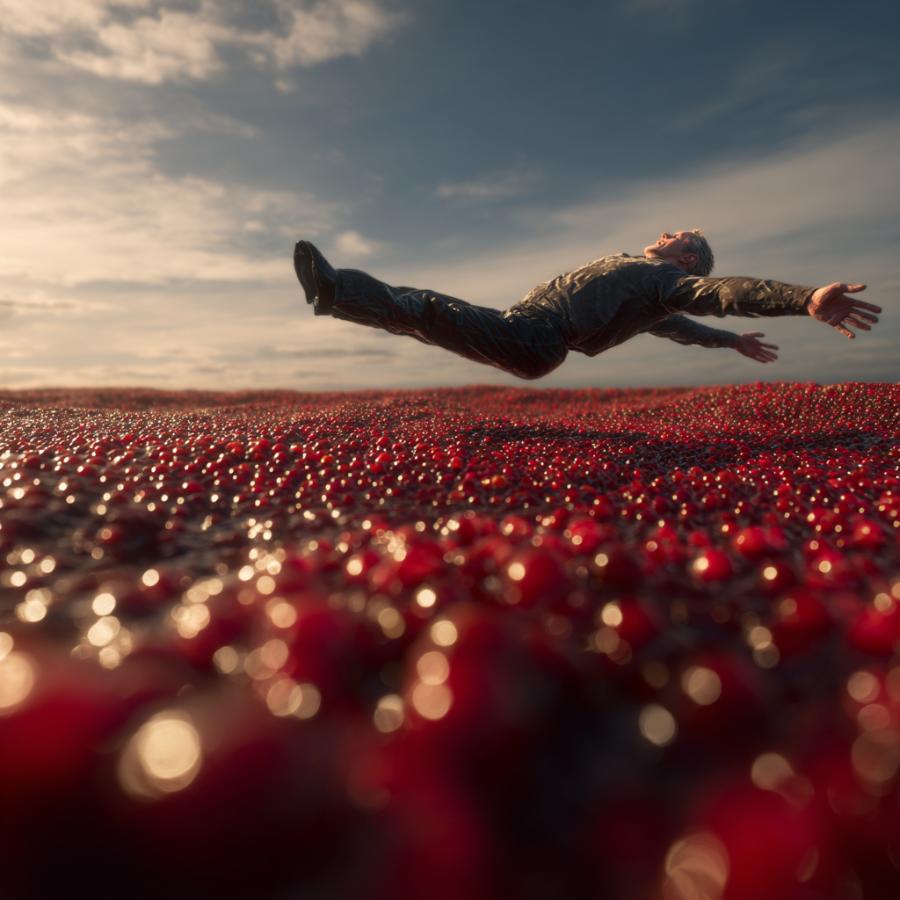
Death Diving into a pile of Cranberries
Ever wonder what it would be like to death dive into a massive pile of cranberries? Obviously you have, I mean who hasn’t? Well, here’s how it would go:
What Would It Actually Feel Like to Death Dive Into a Giant Pile of Cranberries?
Death diving into a giant pile of cranberries would feel like belly flopping onto a wet, lumpy mattress filled with tiny cold marbles. The berries are firm, densely packed, and do not absorb impact well. You’d bounce slightly, sink slowly, and end up soaked in juice from the waist down, smelling strongly of Thanksgiving.
At some point, most people have looked at a pile of something soft and thought, “I could jump into that.” Leaves. Snow. A ball pit at a fast food restaurant from 1994. Cranberries, though, are a different situation entirely. They’re small, they’re round, they’re firmer than they look, and there are sometimes millions of them floating in a single bog at harvest time. The question is not whether you could death dive into a massive cranberry pile. The question is what would happen when you did.
This is a surprisingly physical question that touches on cranberry biology, basic physics, and the Norwegian sport of death diving, which is a real thing. A death dive, called a dødsing in Norwegian, involves jumping from a platform with your body spread wide and flat, then tucking just before water entry to avoid maximum pain. People compete at it. There are judges. Now imagine doing that, but instead of a pool, you’re aiming for somewhere between five thousand and a million cranberries. Let’s think through this.
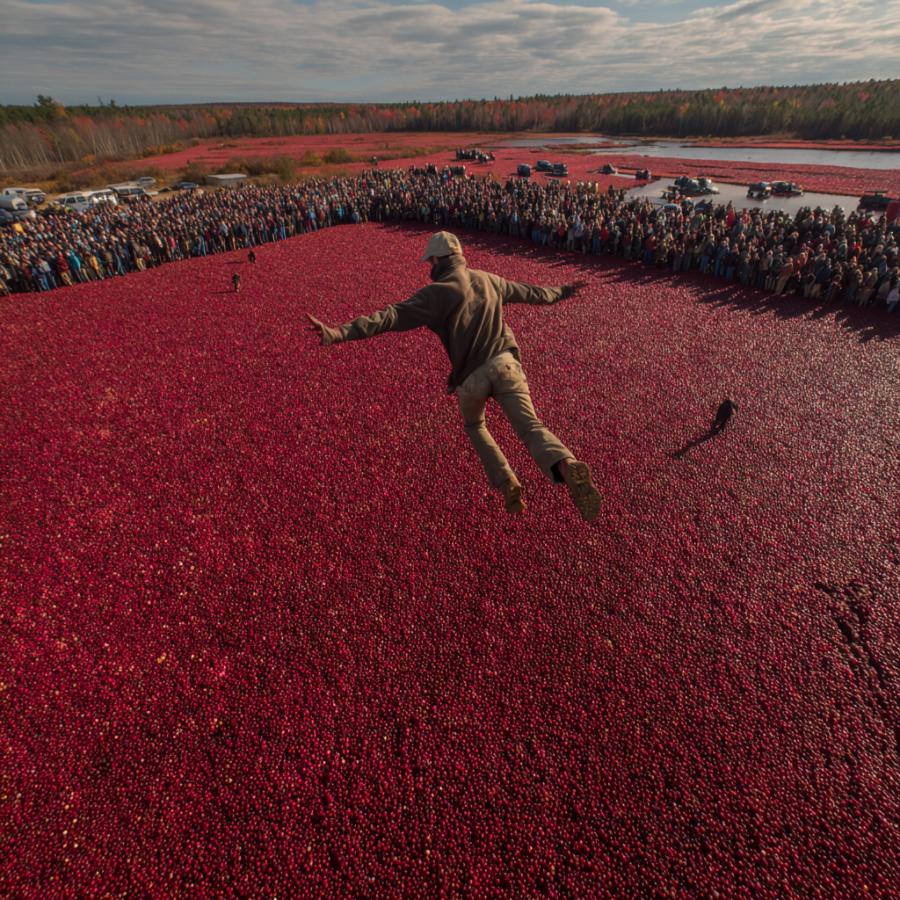
Yeah baby!
What a Cranberry Bog Is Actually Like
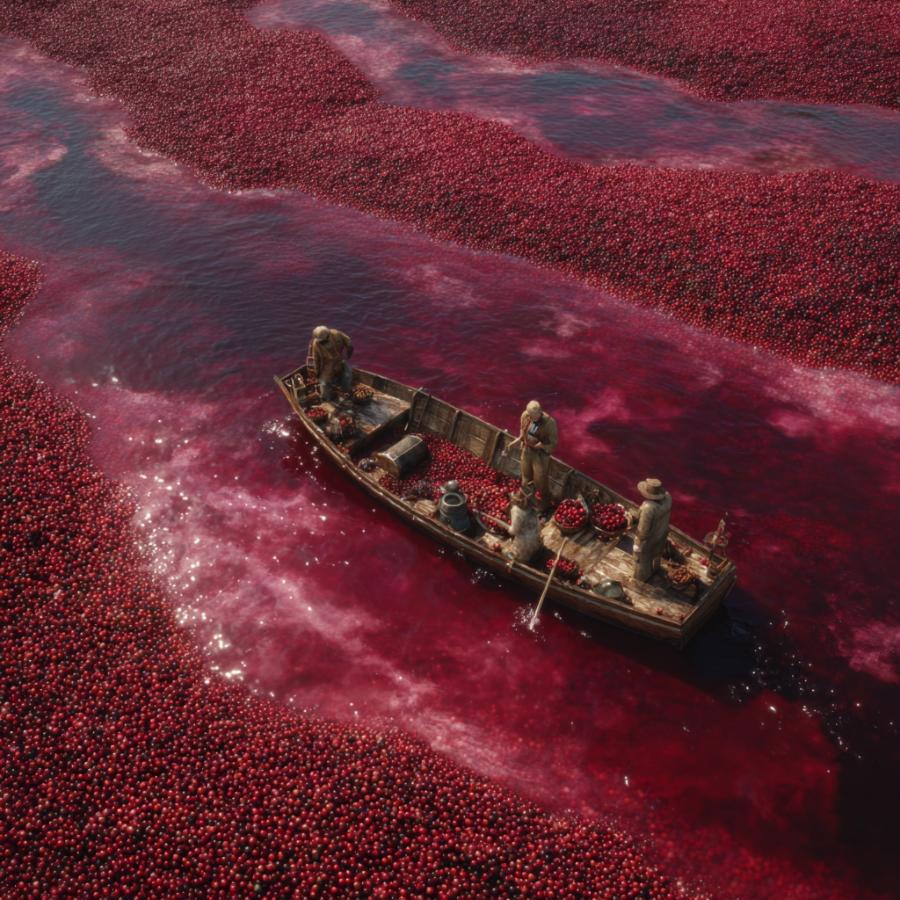
Most people picture cranberry bogs from those Ocean Spray ads where two guys in waders stand in a sea of red berries grinning like they just won something. What those ads don’t show you is that those berries are floating on water. That’s how cranberry harvesting works. Growers flood the fields, then use machines to agitate the water until the berries detach from the vines and float to the surface. A fully flooded cranberry bog looks like someone spilled an enormous bowl of cereal and forgot to add milk.
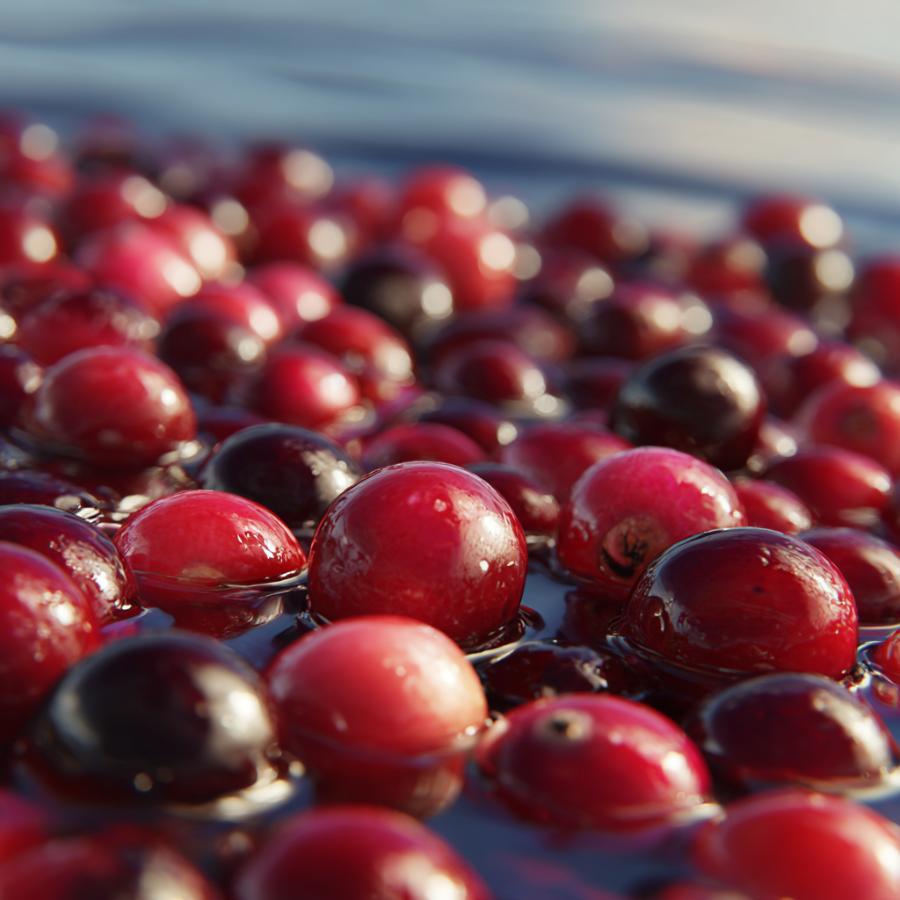
The berries float because they have four small air pockets inside them. That’s not a fun fact someone made up. It’s actual cranberry anatomy. Those air chambers make each berry buoyant, which is why the harvest method works, and it’s also directly relevant to what would happen if you jumped into them. You are not landing on solid ground. You’re landing on millions of floating, slightly squishy objects sitting on top of a shallow lake.
🍒 Cranberry Biology: What You’re Actually Jumping Into
The Physics of Jumping Into Cranberries
A standard death dive happens from about five meters, which is roughly sixteen feet. At that height, you hit the water at around thirty kilometers per hour. Water doesn’t compress, so hitting it flat is genuinely painful, which is why the tuck at the end exists. Now replace the water with cranberries floating on shallow water.
Here’s where it gets interesting. When you hit the cranberry layer, the berries don’t part quickly the way water does. Think of it like jumping onto a foam pit at a gymnastics gym, except instead of soft foam cubes, every piece is a small, firm marble filled with liquid. The cranberries will compress and spread outward, and then you’ll meet the water underneath them. The berry layer is probably no more than one to two feet thick, so the cranberries are not really absorbing your fall. They’re just slowing it down by maybe half a second before the water takes over.
The net result is a two-stage impact. First you hit the berries, which squish and scatter and shoot out sideways with surprising force. Then you hit the shallow water and mud beneath them. It’s less “sinking into a vat of jelly” and more “crashing into a lumpy mattress with a puddle under it.”
📊 Impact Experience: Cranberries vs. Other Jump Surfaces
Estimated unpleasantness on impact — 0 = feather bed, 100 = concrete
100
72
55
30
22
8
* Estimated relative discomfort scale based on material properties and impact physics. Not a clinical measurement. Do not actually do any of these.
What It Would Actually Feel Like, Second by Second
Let’s walk through it in real time, because that’s the only fair way to handle this.
The jump. You’re up on a platform, you’ve committed, and you spread your arms and legs wide in the classic death dive pose. Below you is a cranberry bog at peak harvest, red and vast and completely indifferent to what you’re about to do to it.
The drop. Cold air, which you do not think about because you are focused on not dying. You have about one second if you’re jumping from five meters.
First contact. Your hands and feet hit the berry layer first. The cranberries don’t give way immediately. It feels like landing on a pile of grapes that someone froze slightly. There’s a loud crackling-squelching sound, which is thousands of berries rupturing at once. Several berries shoot out laterally at speeds that could theoretically injure a bystander. (Stand back, bystanders.)
The sink. You don’t sink fast. The berries push back as they compress and the air chambers in them create resistance. Think of trying to push a beach ball underwater. Now imagine doing that with ten thousand beach balls the size of marbles, all at once, with your entire body. You slow down significantly in the berry layer before hitting the shallow water and mud below.
The aftermath. You are now half-submerged in cold water, surrounded by devastated cranberries. There is juice everywhere. Your face, your hair, your clothing, and any skin exposed to the berry layer is now stained a deep pink-red. You smell like cranberry sauce. Not the canned kind. The good kind, with orange zest, which is somehow worse because it’s confusing.
🚨 Things Nobody Warns You About: The Cranberry Aftermath
- The stain is real. Cranberry juice stains skin, fabric, and dignity. The anthocyanins that make cranberries red bond quickly to most surfaces, including you.
- The cold is immediate. Bog water during harvest season in Massachusetts or Wisconsin is typically between 35 and 50 degrees Fahrenheit. That’s cold enough to matter a lot, right away.
- Getting out is harder than getting in. You’re in shallow, churned-up mud with thousands of slippery berries underfoot. Think ice skating, but wetter.
- The smell lingers. Cranberry juice has tannins and organic acids. It won’t wash off in one shower. You’ll know this by your second day.
- You will have wasted a lot of cranberries. A single acre of cranberries can yield up to 17,000 pounds of fruit. Your landing zone probably holds a lot of fruit that somebody was planning to sell.
Is It Safe? Sort of, But Not Really
The honest answer is that a cranberry bog at harvest is not a safe place to do a death dive, and the reasons are more specific than you’d think. The water under the berries is shallow, often only one to two feet deep. If you’re jumping from any real height, your momentum will carry you through the berry layer fast enough that you’ll hit the muddy bottom. Mud sounds soft, but compacted bog mud can be firm, and the angle of your entry matters a lot.
There’s also the cold. Harvesting happens in the fall, and bog water in New England or the Upper Midwest in October is genuinely cold. Cold water immersion doesn’t feel like a big deal right up until your body decides it is a very big deal. Farmers wade in this water with insulated chest waders for a reason.
The berries themselves won’t cut you. Cranberries are smooth-skinned and small. Getting hit in the face by a spray of them at impact would sting, the same way a water balloon to the face stings, but it’s not a laceration situation. The main physical risks are the shallow water depth, the cold, and the general chaos of trying to get your bearings in a slippery, churned-up berry soup.
🏔️ A Brief Note on Actual Death Diving (Dødsing)
Death diving is a Norwegian sport that involves jumping from a 10-meter platform in the most spread-eagle position possible, then tucking just before water entry. It’s been practiced since the 1970s and has formal competitions in Norway each year.
Adapting this sport to a cranberry bog would introduce additional variables. Norwegian judges have not commented on this scenario, as far as we know.
Let’s Talk About the Smell
This section exists because people consistently underestimate it. Cranberries are not subtle fruit. A single cranberry has a sharp, tart, slightly medicinal smell. Multiply that by however many thousands are in the bog around you and you get something that’s less “pleasant autumn walk” and more “inside a Yankee Candle factory when something has gone wrong.”
It’s not a bad smell, exactly. It’s an aggressive smell. Cooks who process fresh cranberries in bulk know that the smell gets into everything and doesn’t leave quickly. After a full-body immersion in a harvest bog, you’d carry that scent for days. Your car would carry it. Your bathroom would carry it. Anyone near you would immediately know what you’d been doing, which might be the most embarrassing part of the whole thing, not the stain and not the mud, but having to explain to people why you smell like pie filling.
If You Somehow Want to Try This
You probably shouldn’t jump into a working cranberry bog for a few obvious reasons. The berries are a commercial crop, and farmers aren’t running an attraction. But cranberry festivals do exist. Ocean Spray hosts tours of harvest bogs in Wareham, Massachusetts each fall. Some festivals let visitors wade into flooded bogs in waders. That’s as close as most people will ever legitimately get.
If you want the full sensory experience without wading into someone’s livelihood, the closest analog is to fill a bathtub with cranberries and cold water and sit in it. This is not a recommendation. It’s a thought experiment with a practical option. You’d get the cold, the stain, the smell, and the sensation of small firm objects pressing against you from every direction. You would not, however, get the freefall or the impact, which is really the point of a death dive.
For that, you’d need the bog. And for the bog, you’d need a very understanding cranberry farmer and probably a waiver. Several waivers. Maybe a lawyer.
The Bottom Line
A death dive into a cranberry bog would not be the soft, forgiving landing that the imagery suggests. It would be cold, loud, disorienting, and immediately followed by a long period of smelling like someone’s holiday dessert. The cranberries wouldn’t cushion you the way foam or snow would. They’d crackle and rupture and spray, and then the shallow water below would remind you that physics hasn’t taken the day off.
It would also be, objectively, one of the more interesting things a person could do in a bog. The Norwegian death diving community has not yet explored this direction. Cranberry farmers have not expressed interest in hosting it. But the potential is there, sitting in a flooded Massachusetts field every October, red and round and completely unprepared for what someone is inevitably going to try.
Posted on cranby.com — your home for everything cranberry. No actual bogs were harmed in the writing of this article. Several cranberries were, in our imaginations.